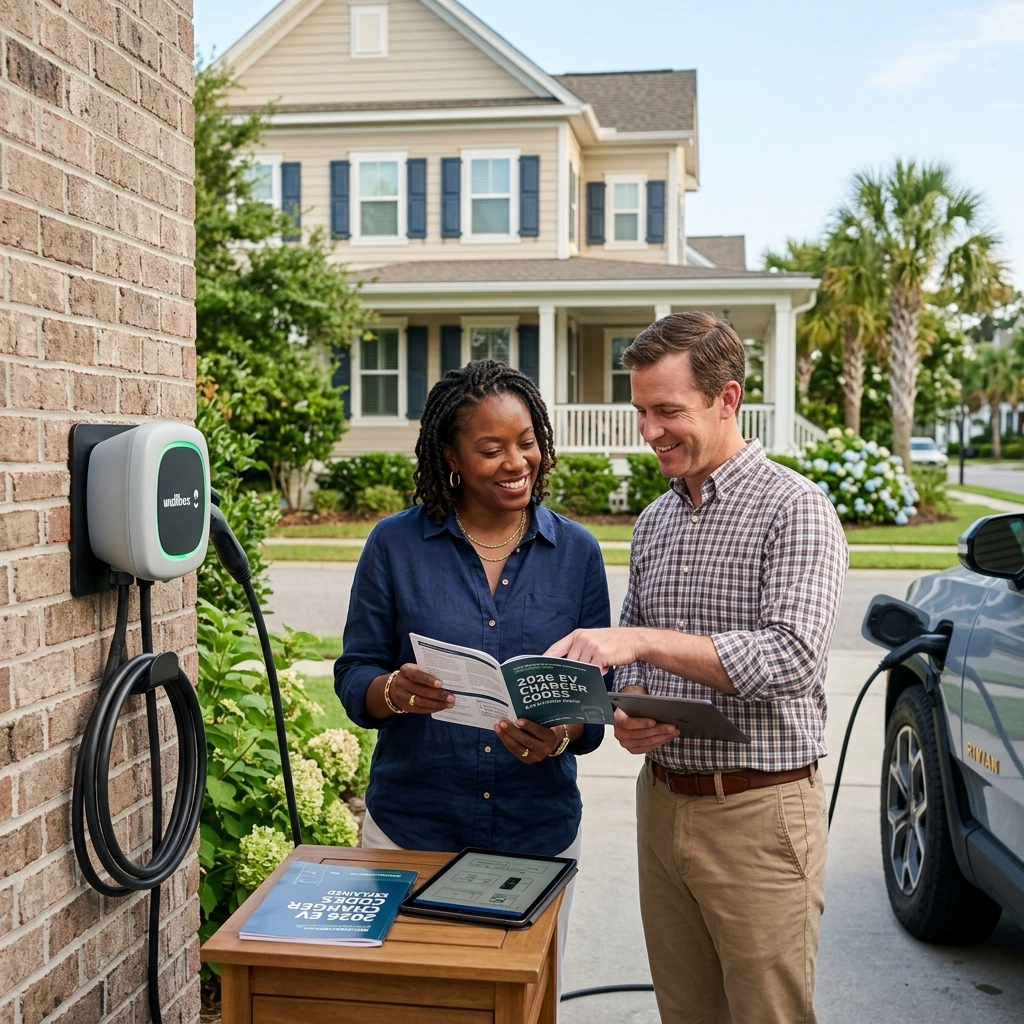
2026 EV Charger Codes for Charleston Homeowners
As Charleston continues to grow, so does the number of electric vehicles (EVs) cruising through the Lowcountry. From the historic streets of downtown to the newer developments in Mount Pleasant and Summerville, homeowners are increasingly looking for ways to charge their vehicles faster and more safely at home. However, the regulatory landscape is shifting. The 2026 National Electrical Code (NEC) has introduced significant updates that change how EV chargers are installed and who is allowed to install them.
For local homeowners, understanding these updates is no longer optional: it is a matter of legal compliance and, more importantly, home safety. If you are planning an EV charger installation in Charleston, SC, you need to be aware of how these new standards affect your property, your budget, and your choice of contractor.
1. The "Qualified Person" Mandate: The End of DIY EV Charging
One of the most significant changes in the 2026 NEC involves the "Qualified Person" requirement. In previous years, many homeowners purchased Level 2 charging stations online and attempted to install them as a weekend DIY project. Under the new 2026 standards, this is effectively a thing of the past.
The updated code now mandates that all permanently installed (hardwired) EV charging equipment must be installed by a "qualified person." In the state of South Carolina, and specifically within Charleston's jurisdiction, this is interpreted as a licensed electrician in Charleston, SC. The complexity of modern EVSE (Electric Vehicle Supply Equipment) requires a deep understanding of load balancing, overcurrent protection, and thermal management that goes beyond the scope of a standard home improvement enthusiast.
 A candid photo of an EmergenServe electrician explaining the technical components of a new EV charger to a Charleston homeowner in a West Ashley garage.
At EmergenServe, we have seen the risks associated with improper DIY installations, including melted wires and scorched terminals. By requiring a licensed professional, the 2026 code ensures that your home's electrical system can handle the continuous high-amperage draw that Level 2 charging demands. This move isn't just about red tape; it's about preventing residential fires in our community. If you are looking to get a charger installed correctly the first time, visit our device installation page to see how we handle these high-stakes projects.
2. The Hardwiring Requirement and the 5mA GFCI Update
In the past, many Level 2 chargers were "plug-in" models that utilized a NEMA 14-50 outlet (similar to a dryer outlet). The 2026 NEC is pushing the industry toward hardwired connections for permanent residential installations. Hardwiring removes the "point of failure" that a plug and socket represent, especially since EV chargers pull a heavy load for hours at a time, which can cause heat expansion and contraction in a standard outlet.
Along with the push for hardwiring comes ongoing discussion around GFCI protection on EV charging circuits. Because 2026 NEC interpretations and local enforcement can vary, Charleston homeowners should not assume every hardwired charger now requires a separate 5mA breaker-based GFCI device in the same way a receptacle circuit might.
This is exactly why local review matters. A licensed electrician in Charleston, SC must confirm charger listing, breaker compatibility, local permit requirements, and the current authority having jurisdiction before installation. Without that verification, homeowners can end up with nuisance tripping, failed inspections, or equipment that doesn't perform as expected.
3. Why Load Calculations and Panel Upgrades are Essential
Charleston is famous for its beautiful, historic homes. However, those historic structures often come with electrical panels that were never designed to power a modern home, let alone a fast-charging electric vehicle. Adding a Level 2 charger to your home is roughly equivalent to adding another central air conditioning unit to your system.
Before any installation, we perform a detailed load calculation. This determines if your current electrical service can handle the extra 40 to 60 amps required for an EV charger. If your panel is already at capacity, adding a charger could lead to frequent tripped breakers or even damage to your main service line.
 A candid photo of an electrician using a digital tablet to perform a load calculation in a Charleston home, ensuring the existing panel can support the new EV demand.
In many cases, an electrical panel upgrade in Charleston, SC is a necessary prerequisite. Upgrading to a 200-amp service ensures that you can charge your car while running your HVAC, dishwasher, and dryer simultaneously without any safety risks. You can learn more about the process on our panel upgrades page. This is particularly important for homes in areas like South of Broad or the Peninsula, where electrical systems may be decades old.
4. South Carolina Act No. 18 and Local Adoption
It is important to understand how national codes become local laws. In South Carolina, the adoption of the NEC is guided by state legislation, such as Act No. 18. This act outlines how the state's Building Codes Council reviews and adopts international and national standards.
Charleston has a history of staying current with safety regulations to protect its residents and its historic architecture. While the NEC 2026 provides the framework, local building departments in Charleston, North Charleston, and Mount Pleasant may have specific amendments or enforcement timelines. Working with a local residential electrician in Charleston, SC ensures that your project will pass inspection and meet all local municipal requirements.
 A close-up, unpolished shot of a newly installed, hardwired Level 2 EV charging station mounted on a brick wall of a Charleston home, showing the clean and secure professional finish.
5. Integrating EV Charging into Your Whole-Home Electrical Plan
An EV charger shouldn't be an afterthought. At EmergenServe, we view it as part of a larger strategy for home energy management. If you are already considering a kitchen remodel or a lighting redesign, that is the perfect time to address your EV charging needs.
Planning ahead can save you thousands of dollars. For example, if we are already performing remodel wiring, we can run the necessary conduit for your future EV charger even if you haven't bought the car yet. This "EV-ready" approach is becoming the standard for smart homeowners in the Lowcountry.
6. The EmergenServe Difference: Professionalism and Local Roots
We aren't a giant, faceless corporation. EmergenServe is a family-run business that understands the specific needs of Charleston homeowners. We know that when you call for an EV charger installation in Charleston, SC, you are looking for a team that treats your home with respect and prioritizes your family's safety.
Our technicians are fully trained on the 2026 NEC updates. We handle everything from the initial safety inspection and load calculation to the final permit and installation. We take the guesswork out of the new codes so you can enjoy the convenience of your EV without worrying about the underlying electrical infrastructure.
 A candid photo of an EmergenServe electrician and a Charleston homeowner standing in front of an open electrical panel, discussing the upgrades needed for a new EV charger installation.
Summary of Key 2026 Changes
| Feature | Old Standard | 2026 NEC Standard |
|---|---|---|
| Installer | DIY or Handyman | "Qualified Person" (Licensed Electrician) |
| Connection | Plug-in (NEMA 14-50) | Preference for Hardwired |
| GFCI Protection | Receptacle-based rules varied by setup | Verify current 2026 NEC interpretation, charger listing, and local AHJ requirements |
| Permitting | Often bypassed | Mandatory Local Inspection & Load Calc |
Get Your Home Ready for the Future
The move toward more stringent EV charger codes is a clear sign that electric vehicles are no longer a niche hobby: they are a core part of our modern infrastructure. By adhering to the 2026 NEC, you aren't just following the law; you are investing in the long-term resilience and safety of your Charleston home.
If you're ready to upgrade your home's charging capabilities or if you have questions about whether your current panel can handle the load, don't hesitate to reach out. At EmergenServe, we're here to help you navigate these new regulations with ease and professional expertise.
Explore our full range of residential services or contact us today to schedule your consultation. Let's make sure your home is ready for the road ahead.