
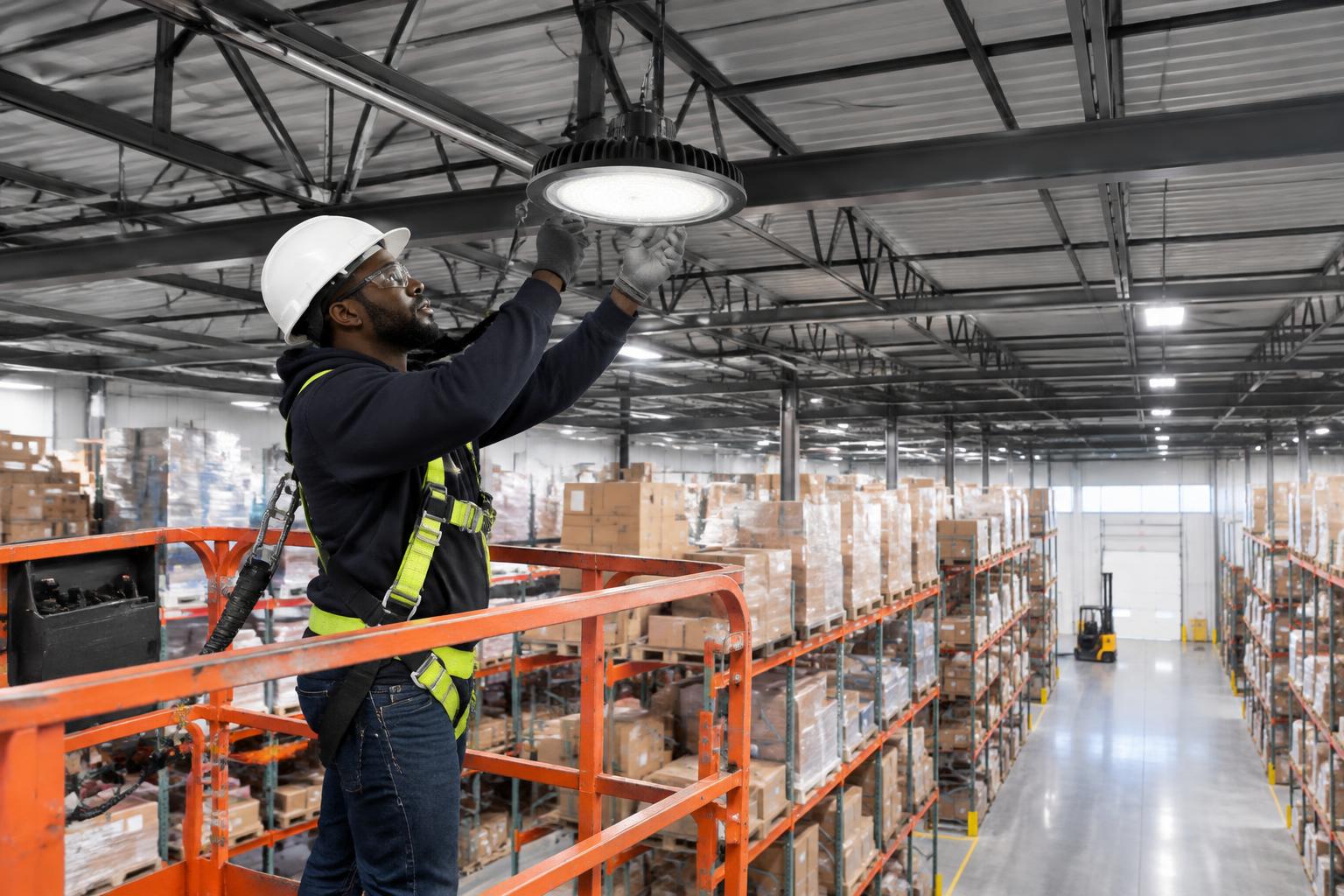
7 Alternatives to Traditional Warehouse Lighting
Table of Contents
- Why Traditional Warehouse Lighting Is Costing You More Than You Think
- The 7 Alternatives at a Glance
- The LED Warehouse Lighting Upgrade: The Baseline Alternative
- High Bay LED Lights for Warehouses: Choosing the Right Output and Beam
- Warehouse Lighting Controls and Occupancy Sensors: Cut Waste Automatically
- Daylighting and Skylights: Free Light You Are Not Using
- Warehouse Lighting Retrofit Cost: What Drives the Number
- Schedule a Warehouse Lighting Assessment
- Frequently Asked Questions
Reviewed: November 9, 2026. Savings, rebates and code requirements depend on the facility, utility and jurisdiction.
Key takeaway: The main alternatives to traditional warehouse lighting are LED high bays, lighting controls and occupancy sensors, and daylighting through skylights and clerestory windows. Many facilities combine them: LEDs reduce energy and maintenance, while controls and daylighting reduce wasted light hours.
Why Traditional Warehouse Lighting Is Costing You More Than You Think
Warehouse operators in North Charleston, SC often treat lighting as a fixed cost, but it is a line item that can be reduced. Traditional high-intensity discharge (HID) fixtures, such as metal halide and high-pressure sodium lamps, convert a smaller share of their input power into light than modern LED fixtures. Their output also declines gradually, so the floor can get dimmer for months before anyone notices.
The U.S. Department of Energy's solid-state lighting program has tracked how LED efficacy has overtaken legacy sources. That efficiency gap is a core reason LED options dominate many new construction and retrofit projects.
This guide covers practical options and where each one may fit, from a full LED replacement to controls, daylighting and better maintenance.
The 7 Alternatives at a Glance
- LED high bay fixtures replacing HID high bays
- LED linear or low bay fixtures for lower ceilings, offices and staging areas
- Occupancy and vacancy sensors for aisles and rarely used zones
- Daylight harvesting that dims fixtures when natural light is sufficient
- Scheduling and zoning controls matched to shifts and work areas
- Daylighting through cleaned, cleared or added skylights and clerestory windows
- Networked lighting controls that combine sensing, scheduling and reporting
The LED Warehouse Lighting Upgrade: The Baseline Alternative
An LED warehouse lighting upgrade replaces HID fixtures with LED high bays, and it is the option every other alternative is usually measured against. LEDs typically deliver more lumens per watt, maintain their rated output for longer, and switch on without the warm-up and restrike delay of many HID lamps.
What many guides miss is that the fixture swap is only part of the value. The rest comes from reducing the maintenance cycle. HID lamps and ballasts need periodic replacement, and every replacement means a lift, a technician and a blocked aisle. Rated LED life varies by product, but longer intervals between service visits can matter as much to a busy distribution center as the wattage savings.
For facilities considering a project, our commercial lighting retrofitting service covers layout, fixture selection and installation planning.
High Bay LED Lights for Warehouses: Choosing the Right Output and Beam
High bay LED lights for warehouses are not a single product; they are a category defined by mounting height, beam distribution and output. Picking the wrong combination is a common retrofit mistake, and it shows up as hot spots on the floor and dark aisles between racks.
The decisions that matter:
- Mounting height: higher ceilings often need narrower distributions to put light where it is needed
- Beam pattern: narrower or aisle optics for tall racking, wider distributions for open floor and staging areas
- Output: match delivered light to the task, not to the old fixture's wattage
- Color temperature and color rendering: choose for the work being done, such as reading labels or inspecting goods
A common mistake is matching the new fixture's wattage to the old HID lamp. Because LEDs are more efficient, an equivalent-wattage LED can overlight the space. A photometric layout based on the task and the racking plan is a better starting point.
Facilities with 480-volt systems, motor loads or VFDs should review the electrical requirements of light industrial projects before choosing drivers and controls.
Warehouse Lighting Controls and Occupancy Sensors: Cut Waste Automatically
Warehouse lighting controls and occupancy sensors cut waste by turning light off or dimming it when an area is empty. In a facility with intermittent traffic, such as seasonal storage or a loading dock used in bursts, controls can add meaningful savings on top of the fixture swap.
The practical options stack in layers:
- Occupancy sensors for aisles, restrooms and rarely used zones
- Daylight harvesting that dims fixtures when natural light is strong
- Scheduling for shifts, breaks and overnight windows
- Zoning so one active aisle does not light the whole floor
The catch is commissioning. Badly placed sensors or wrongly mapped zones produce complaints and get bypassed. Plan the layout before installation, and confirm whether the locally adopted energy code requires specific controls when lighting is altered.
Daylighting and Skylights: Free Light You Are Not Using
Daylighting captures natural illumination through skylights and clerestory windows. Many facilities already have skylights that are dirty, painted over or blocked by racking, so the light never reaches the floor.
Improving that can be a maintenance task rather than a construction project, but roof and skylight work is a fall hazard and belongs with qualified crews using proper fall protection. Once glazing is clean and the light path is clear, pair daylight with dimming controls so fixtures ease off when the sun is out. The DOE's daylighting guidance explains the principles behind it.
Watch out: daylighting without controls wastes much of the benefit, because fixtures stay at full output while the sun does the work. Plan the two together.
Warehouse Lighting Retrofit Cost: What Drives the Number
Warehouse lighting retrofit cost depends on fixture count, ceiling height, electrical infrastructure and whether controls are added. No single figure applies across facilities.
The main cost drivers:
| Cost Driver | What It Covers | Why It Moves the Number |
|---|---|---|
| Fixture count and type | High bays, linear, low bays | More fixtures, more material and labor |
| Ceiling height | Lift rental and access time | Taller ceilings slow installation |
| Electrical condition | Panel capacity, wiring, voltage | Upgrades add scope beyond lighting |
| Controls | Sensors, dimming, commissioning | Adds hardware and setup time |
| Rebates | Utility incentive programs, where available | May offset part of the project if eligible |
Electrical condition is often underestimated. Older facilities sometimes need panel or wiring work before new fixtures go in, and that changes the budget. EmergenServe provides an itemized written commercial bid identifying scope, equipment, materials, labor, required permits and exclusions; we confirm the bid-delivery date after reviewing the plans and site, with no fixed turnaround for every project. Property managers can also review commercial LED lighting retrofits for Charleston property managers.
Schedule a Warehouse Lighting Assessment
Lighting is one of the warehouse systems where an upgrade can lower operating costs over time. The alternatives to traditional warehouse lighting, from a full LED retrofit to controls and daylighting, all target wasted energy and maintenance, and many facilities combine them.
EmergenServe is a family-owned, licensed electrical contractor serving commercial and light industrial facilities across the Lowcountry. We answer emergency calls 24/7; arrival timing depends on location, conditions, demand and crew availability. Call (843) 754-1671 to discuss your facility.
Frequently Asked Questions
Are LED lights better than traditional warehouse lights?
For many warehouses, yes. LED high bays typically use less energy than comparable HID fixtures for the same delivered light, start without a warm-up delay, and need less frequent maintenance. The right choice still depends on mounting height, racking layout, the tasks performed and the existing electrical system, so a lighting layout should come before fixture selection.
What color temperature is best for warehouse lighting?
There is no single best value. Neutral to cool white light is common in industrial spaces, while some picking, packing and inspection areas benefit from a specific color temperature and higher color rendering. Choose based on the work being done, consistency across the space and glare control, and keep the selection uniform within each zone.
How much does it cost to upgrade warehouse lighting to LED?
Cost depends on fixture count and type, ceiling height and lift access, electrical condition, controls and any available utility incentives. A facility that needs only fixture replacement costs less than one that also needs panel, wiring or controls work. Request an itemized written bid for your facility rather than relying on a per-fixture average.
Are motion sensors worth installing in a warehouse?
They are most useful where areas sit empty for long periods, such as storage aisles, seasonal zones, restrooms and docks used in bursts. In continuously occupied areas, scheduling or daylight dimming may matter more. Sensor placement and commissioning determine whether they work; check whether the locally adopted energy code requires controls when lighting is altered.
