
Does Homeowners Insurance Cover Knob and Tube Wiring?
Table of Contents
- Does Homeowners Insurance Cover Knob and Tube Wiring?
- How to Identify Knob and Tube Wiring in Your Home
- Homeowners Insurance Knob and Tube Wiring Requirements
- What to Tell Insurance About Knob and Tube Wiring
- Knob and Tube Wiring Replacement Cost: What Drives the Price
- Where Insurers Commonly Land: Possible Coverage Outcomes
- Schedule a Knob and Tube Inspection Before Your Next Renewal
- Frequently Asked Questions
Reviewed: November 9, 2026. General information, not insurance or legal advice; your carrier's underwriting rules and policy language control.
Key takeaway: Many homeowners insurance companies will not cover a home with active knob and tube wiring, or will cover it only with conditions. Ask your carrier exactly what it requires; an electrician's inspection or replacement work does not by itself guarantee coverage or renewal.
Does Homeowners Insurance Cover Knob and Tube Wiring?
Many homeowners insurance companies will not write a policy on a home with active knob and tube wiring, or will do so only with conditions attached. The short answer to "does homeowners insurance cover knob and tube wiring" is that it depends on the carrier: many treat it as a higher-risk feature, and coverage often depends on how much of the system remains, its condition, and whether a licensed electrician has documented it.
That surprises a lot of people. Knob and tube was common in homes built before the 1950s, and plenty of those homes still stand across North Charleston and the wider Lowcountry. Insurers look at risk: knob and tube wiring has no equipment ground conductor, and its original insulation can become brittle over decades.
Below, we break down what insurers commonly ask for, what to tell them, and what replacement involves.
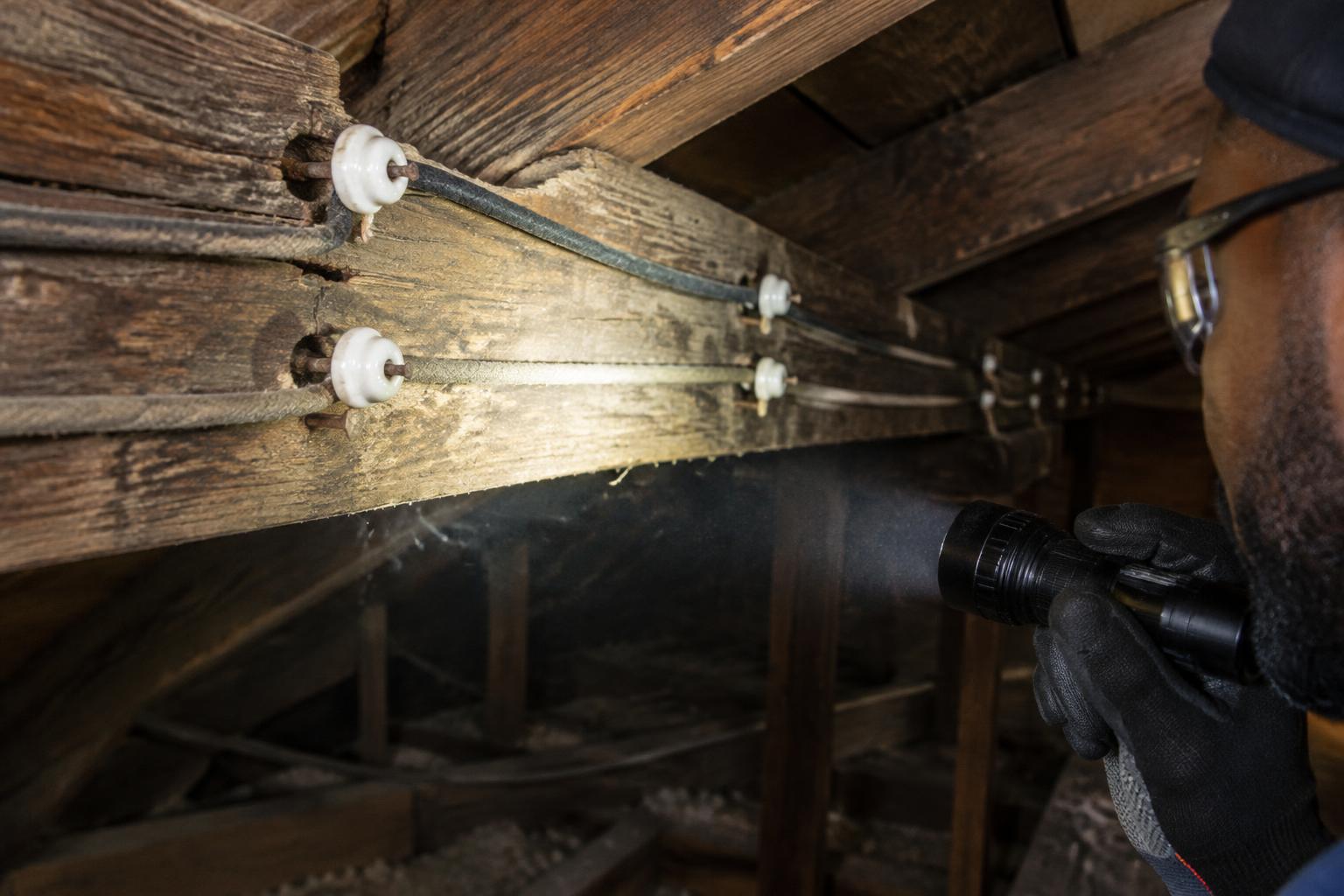
Knob and tube wiring is an early electrical system that runs individually insulated conductors through ceramic knobs and tubes instead of modern cable. It has no ground wire and was designed to dissipate heat in open air.
How to Identify Knob and Tube Wiring in Your Home
Look in the attic, basement and crawlspace first. Knob and tube wiring is easiest to spot where framing is exposed. Look from a safe position with a flashlight; do not touch, pull or move old wiring, and stay off ceiling drywall between joists.
Here is what to look for:
- Ceramic knobs: small white or beige spools fastened to joists, holding wire away from wood.
- Ceramic tubes: short hollow cylinders set into drilled holes where wire passes through framing.
- Cloth or rubber insulation: fabric-covered wire that may look cracked, brittle or frayed.
- No ground wire: conductors run separately, with no bare or green grounding conductor.
- Splices outside boxes: older joints may sit in open air rather than inside a junction box.
Wiring hidden behind finished walls usually cannot be identified from the outside. An infrared scan shows heat patterns at energized, loaded equipment; it does not reliably reveal the type of wiring inside a wall. An infrared electrical inspection can help find hot connections, while an electrician's visual evaluation at accessible boxes, the panel, the attic and crawlspace is how knob and tube is usually confirmed.
What Knob and Tube Looks Like in an Attic or Basement
In an attic, the giveaway is the pattern: separate conductors run in parallel lines, spaced apart, held by knobs. That open spacing was part of the original design, which is why buried knob and tube under insulation is a concern and a common insurer question.
In a basement or crawlspace, look along the joists near where wiring enters the home. You may see old knob and tube feeding a few original circuits while newer cable handles the rest. That mixed setup is common in homes that have been updated in stages.
Homeowners Insurance Knob and Tube Wiring Requirements
Underwriters often want evidence that the system is in acceptable condition, or evidence that it is gone. Requirements vary by carrier, but they tend to fall into a few patterns:
| Possible insurer position | What it may require | What it can mean for you |
|---|---|---|
| Will not insure | No active knob and tube | Replacement first, or a different carrier |
| Insures with conditions | Licensed electrician's inspection and written report | You pay for the inspection and any repairs |
| Insures at a higher premium | Documentation of condition | Higher annual cost if coverage continues |
| Requires replacement on a timeline | Written plan and proof of completion | Coverage terms may change if the deadline passes |
A common request is a written inspection from a licensed electrician. Some carriers also ask about the panel, especially if the home still has an older fuse box. A fuse box or brand name alone does not establish that replacement is needed, but its condition and compatibility should be assessed.
A panel with available breaker space and capacity can make a phased rewire practical. Equipment in poor condition or without capacity can expand the scope, and that changes the conversation with the insurer.
What to Tell Insurance About Knob and Tube Wiring
Be direct. Tell the insurer the system exists, roughly how much of the home it serves, and what has been done about it. Misrepresenting it on an application can give the insurer grounds to deny a claim or rescind a policy later.
Here is a simple script to use when you call:
"The home has original knob and tube wiring on [number] circuits serving [rooms]. A licensed electrician inspected it on [date]. The report notes [condition]. We have [replaced / scheduled replacement of] the circuits serving [areas]."
Then have these documents ready:
- The electrician's written inspection report
- Photos of the accessible wiring taken from a safe position
- Any permits for prior electrical work
- Receipts for panel work or repairs
If you are buying the home, get the inspection before closing. It is far easier to negotiate a credit than to argue with an underwriter after the policy is bound.
Knob and Tube Wiring Replacement Cost: What Drives the Price
Replacement pricing depends on home size, how many circuits remain, wall and ceiling access, occupancy, finish restoration and whether panel work is needed. EmergenServe provides free written project estimates for defined-scope rewiring; diagnostic and troubleshooting visits are separate paid service calls. Timing is set after assessing the property, including planned shutdowns and any finish restoration.
If the evaluation points to panel work, our electrical panel replacement page explains what the job involves, and complete home rewiring covers phased and whole-home projects.
Partial Rewiring vs. Whole-Home Replacement
Partial rewiring replaces selected circuits first, often those serving kitchens, bathrooms, laundry and modern appliances. It costs less up front and disrupts less. The catch is that remaining knob and tube still sits in the walls, and some insurers will not accept a partial job.
Whole-home replacement removes every knob and tube circuit still in service. It is a larger project and often simplifies the insurance conversation, but carriers still apply their own underwriting rules. For a historic home, a room-by-room plan can make more sense than a single gut renovation.
Where Insurers Commonly Land: Possible Coverage Outcomes
Outcomes vary by carrier, policy and the home itself. These scenarios are common starting points for a conversation with your agent, not predictions.
| Scenario | Possible outcome | Best next step |
|---|---|---|
| Active knob and tube, no inspection | Declined, conditioned or non-renewed | Get an inspection, then plan next steps |
| Active knob and tube, documented condition | Conditional coverage or a higher premium | Ask for requirements and any deadline in writing |
| Partial replacement, documented | Varies by carrier | Ask how remaining circuits are treated |
| Full replacement with permits | Often eases underwriting; not guaranteed | Keep permits and receipts on file |
Watch out: a policy that excludes the old circuits can leave you with a claim denial if a loss traces back to them. Read the exclusion language and ask your agent to confirm it in writing before you sign.
Schedule a Knob and Tube Inspection Before Your Next Renewal
Renewal is when carriers often re-check the details, and a surprise notice is worse than a planned inspection. Get ahead of it.
A licensed electrician can document the accessible condition of the system, flag hazards, and give you a written scope you can share with your insurer. A whole-home safety inspection and a limited insurance electrical inspection are different services, so confirm the scope and written price when scheduling.
For homeowners ready to act, electrical safety inspections include a written report of accessible areas. If the inspection points to panel work, electrical panel replacement for Charleston homes is available.
EmergenServe is a family-owned, licensed electrical contractor serving North Charleston and the Lowcountry. Same-day or next-day appointments may be available; we confirm the next window for your location and project. Required inspections never happen or pass the same day; allow at least one day and confirm availability. Call (843) 754-1671 or book online to discuss the inspection scope.
Frequently Asked Questions
Does homeowners insurance cover knob and tube wiring?
Many standard homeowners policies are not available on homes with active knob and tube wiring without conditions. Some insurers decline, exclude the wiring, or require replacement before binding. Others accept it after a licensed electrician's inspection documents its condition. Because underwriting rules vary by carrier and state, ask your agent directly whether knob and tube wiring is eligible and what documentation they need.
Will insurance companies insure a house with knob and tube wiring?
Some will, with conditions. Insurers that accept knob and tube wiring may require a recent inspection by a licensed electrician, confirmation that it has not been improperly altered, and confirmation that it is not buried in thermal insulation. Others issue a policy with a wiring exclusion or a higher premium. If your carrier declines, an independent agent can tell you whether other carriers or surplus lines insurers offer coverage, usually at a higher rate.
Can an insurer deny a claim because a home has knob and tube wiring?
It can, depending on the policy. A loss caused by deteriorated knob and tube conductors may be denied if the policy carries a wiring exclusion or if the wiring was not disclosed on the application. How unrelated perils are handled depends on the policy language. Read the exclusions and ask your agent to confirm in writing how the wiring is treated.
Do I have to disclose knob and tube wiring when applying for homeowners insurance?
Insurance applications commonly ask about the home's electrical system, and misrepresenting it can give the insurer grounds to rescind the policy or deny a claim. Tell your agent what you know, including whether the wiring is partial or throughout the home, and provide an inspection report if you have one. Disclosure lets the insurer offer a conditional policy or path to coverage instead of disputing it after a loss.
How can I find out whether my home still has knob and tube wiring?
From a safe position, check the attic, basement and crawlspace for white ceramic knobs, ceramic tubes through joists and cloth-covered conductors running separately rather than in a cable. A home inspection often flags it, but a licensed electrician's evaluation is more reliable. Wiring hidden behind finished walls may not be fully traceable without opening some surfaces, so ask the electrician to state which areas were accessible.
