
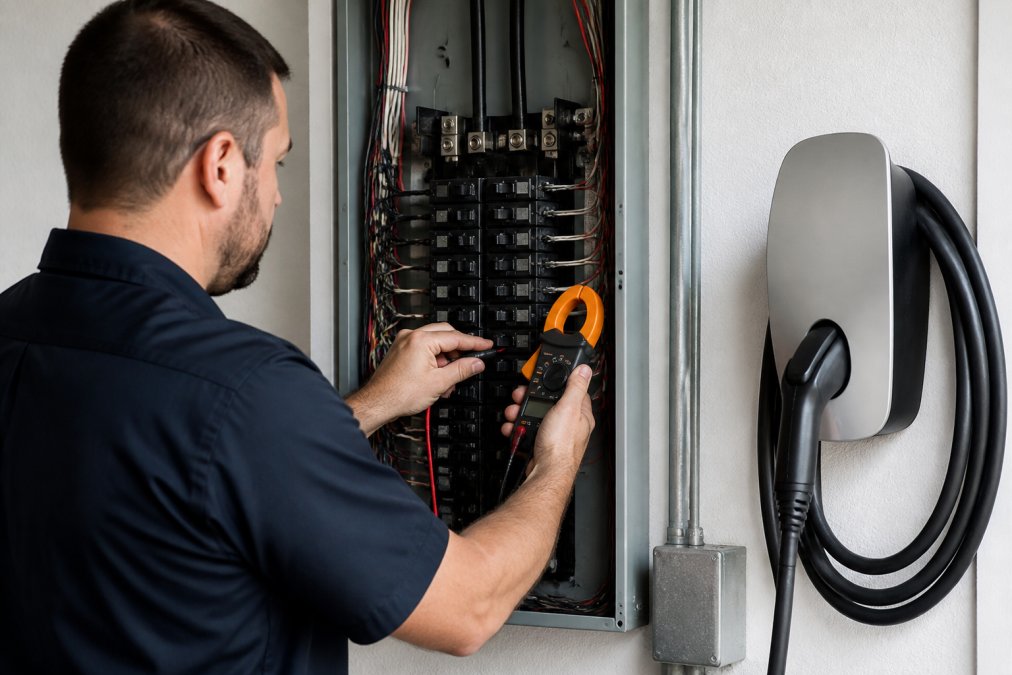
How to Check Electrical Panel Capacity for EV Charger
Table of Contents
- Understanding Your Electrical Panel and Main Breaker
- How to Perform an Electrical Load Calculation for EV Charger Installation
- Signs Your Electrical Panel Is Overloaded
- Checking Available Circuit Spaces and Amperage Rating
- Load Management Devices for EV Chargers: A Modern Alternative
- When You Need a Panel Upgrade vs. Load Management
- Next Steps: Getting Professional Verification
- Frequently Asked Questions
Last Updated: September 27, 2026
Understanding Your Electrical Panel and Main Breaker
Your electrical panel receives electricity from the utility company and distributes it through individual circuits. The main breaker at the top controls the total amperage entering your home.
The main breaker rating (typically 100, 150, or 200 amps) tells you how much electrical current your system can handle. Before installing a Level 2 EV charger, you must know how to check electrical panel capacity for ev charger installation to determine if your panel can support the additional demand.
To find your main breaker rating, open your electrical panel door and look at the large breaker at the top, the amperage is printed on it. If you cannot find it, check your electrical documentation or call a professional.
How to Perform an Electrical Load Calculation for EV Charger Installation
A load calculation determines your home's current electrical demand and remaining capacity, the critical step for checking electrical panel capacity for ev charger installation.
List every major appliance (water heater, air conditioning, electric range, dryer, heating system). Find the wattage on your electric bill or appliance documentation, then divide by 240 volts to get amps.
Example: A water heater (4,500 watts ÷ 240 volts = 18.75 amps), central air (30 amps), electric range (40 amps).
Available capacity requires an applicable load calculation or other code-permitted assessment, not adding breaker ratings or applying a universal 80% panel limit. EV charging is a continuous load and its circuit must be sized accordingly.
Calculate available capacity: multiply main breaker amperage by 0.8, then subtract your current load. The result is your available amperage for an EV charger.
Example calculation:
A 200-amp main breaker indicates the service rating, not a fixed 160-amp usable-load limit. An electrician assesses capacity using applicable load-calculation rules and any approved load-management design.
Next Steps: Getting Professional Verification
After you've completed your own assessment, professional verification prevents costly mistakes.
Frequently Asked Questions
How many amps do I need for a Level 2 EV charger?
Most Level 2 EV chargers require 40-50 amps of dedicated circuit capacity. A typical home charger draws 30-40 amps during operation. Your electrical panel must have enough available amperage and an open breaker slot to accommodate this dedicated circuit. The exact requirement depends on your charger model and your vehicle's charging speed specifications. A professional load calculation ensures you have sufficient capacity without overloading your service.
What happens if I install an EV charger on an overloaded electrical panel?
Installing a charger on an overloaded panel creates serious safety risks: breakers may trip frequently, cutting power to your home; wiring can overheat, increasing fire hazard; and you violate the National Electrical Code (NEC), which requires proper overcurrent protection. An overloaded panel cannot safely handle the continuous load demand of an EV charger. This is why a load calculation is essential before installation to confirm your panel has the capacity to safely support the additional electrical demand.
Can I use load management devices instead of upgrading my electrical panel?
Yes. Load management devices (EVEMS) can help by automatically adjusting your charger's power draw based on available capacity in your home. These systems monitor your panel's load and reduce EV charging speed when other appliances demand power, preventing overload. This is often more affordable than a full panel upgrade and works well if your panel has adequate total amperage but limited available breaker space. However, if your main breaker is undersized or your service entrance is too small, a panel upgrade may be necessary.
Do I need a 200 amp panel for an EV charger?
Not necessarily. A 100 amp panel can support an EV charger if you have sufficient available amperage after accounting for existing loads. There is no universal 80% panel limit applied this way; use the applicable load-calculation and continuous-load circuit-sizing rules. A 200 amp panel provides more flexibility and available capacity, especially in larger homes with multiple high-demand appliances. A load calculation will determine whether your current panel size is adequate or if an upgrade is needed.
Need a charger installed at your home? See our EV charger installation services in Charleston, SC for permitted, inspected Level 2 installs across the Lowcountry.
