
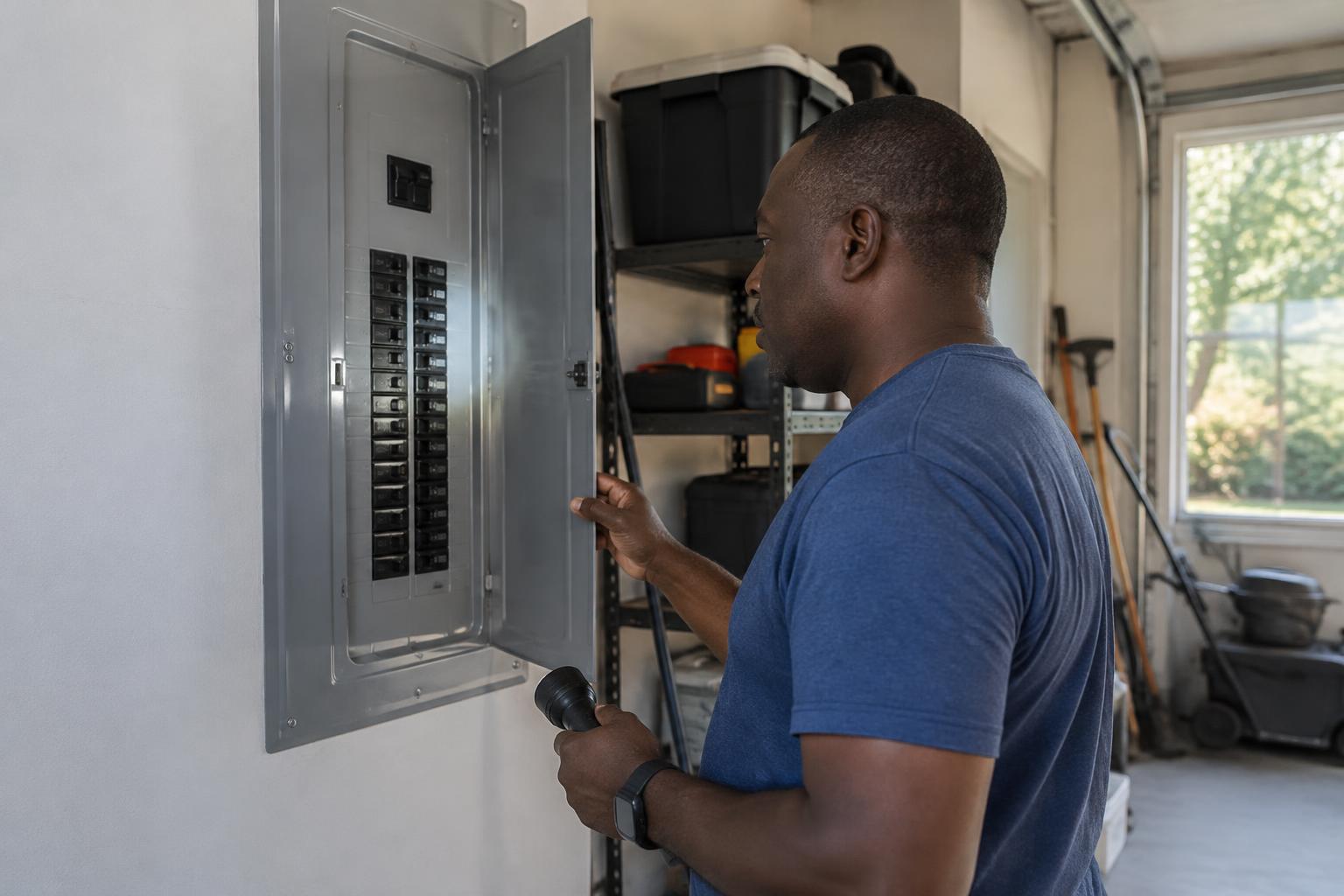
Where Is the Main Breaker Box in Your House?
Table of Contents
- Start With the Obvious Spots: Garage, Utility Room, and Exterior Walls
- Room-by-Room Checklist to Locate the Breaker Box
- Is the Main Breaker Outside the House or Inside?
- How to Identify the Main Breaker in an Electrical Panel
- Does Every House Have a Breaker Box?
- What to Do if You Can't Find the Breaker Box
- Safe Search Boundaries: When to Stop and Call an Electrician
- Schedule a Panel Inspection With EmergenServe
- Frequently Asked Questions
Reviewed: November 16, 2026. General homeowner safety guidance. If you see sparks, smoke or flames, leave the area and call 911 first.
Key takeaway: Most main breaker boxes sit in the garage, a utility room, a basement, or on an exterior wall near the electric meter. Look for a gray or beige metal box with a hinged door and rows of breaker switches inside. If you find only a single switch outside near the meter, keep looking inside for the full panel.
Start With the Obvious Spots: Garage, Utility Room, and Exterior Walls
Most main breaker boxes in American homes sit in the garage, the basement, or a utility room. If you need to know how to find the main breaker box in your house, start in those spots before you search anywhere else. This guide walks through a search most homeowners can finish in a few minutes.
Here's the short version: look for a gray metal box with a hinged door, mounted around eye level, with rows of switches inside. That's almost always it.
Builders put panels where they're easy to reach and close to where power enters the home. Basements are rare in the Lowcountry because of the high water table, so in North Charleston homes the panel is most often on a garage wall, in a utility or laundry room, or outside near the electric meter.
What a Main Electrical Panel Looks Like
A main electrical panel is a metal cabinet that holds the circuit breakers for the circuits in your home. It has a hinged door, rows of breaker switches inside, and usually a paper or sticker circuit directory on the inside of the door.
Look for these features:
- A gray or beige metal box, roughly the size of a large picture frame
- A hinged door that swings open on one side
- A larger main switch, often at the top and often labeled "Main"
- Rows of breaker switches, often 20 to 40 of them
- A circuit directory listing rooms and appliances
Some panels sit flush with the wall. Others stick out. Either way, the hinged door is the giveaway.
Room-by-Room Checklist to Locate the Breaker Box
Work through this list in order and jot down each stop in your phone's notes app as you go. Recording what you checked keeps you from searching the same closet twice and gives an electrician a useful map if you need to call one.
- Garage: check both side walls, the corner near the overhead door, above the workbench, and behind stored boxes.
- Basement: if your home has one, look near the stairs, along the foundation walls, and beside the furnace or water heater.
- Utility room: check beside the HVAC air handler, water heater, or washer hookup.
- Laundry room: look above or beside the washer and dryer, and on the wall opposite the door.
- Hallway: check the walls near bathroom and bedroom doors for a flush panel painted the same color as the wall.
- Closets: open the coat closet and linen closet and look high on the wall, above the shelf line.
- Kitchen: check the pantry and the wall behind the refrigerator.
- Exterior: walk the back and side walls and look near the electric meter for an outdoor service disconnect or panel.
- Shared or locked spaces: in rentals and multifamily buildings, check a locked utility closet, a common hallway, or a landlord-controlled equipment room.
Closets, Hallways, and Laundry Rooms
Interior panels hide in plain sight. A breaker box behind a closet door can look like part of the wall until you open it, so check high on closet walls, above the shelf line. In hallways, look for a flush panel painted the same color as the wall. In laundry rooms, the panel often sits above the appliances or on the wall opposite the door. If a wall has a rectangular seam or a small latch, that's worth a closer look.
Exterior and Meter-Area Panels
Many homes have an outdoor service disconnect or panel near the electric meter, and in South Carolina that exterior box is common. It may hold only a single main switch, or it may be the full panel. Finding it does not mean you have found the only panel, so keep looking inside for the full rows of breakers. A common pattern is an exterior service disconnect at the meter feeding an interior panel in the garage or utility room.
Rental, Multifamily, and Shared-Building Situations
If you rent or live in a multifamily building, the panel may be locked, shared, or controlled by the landlord. Do not pry open a locked panel or operate another unit's breakers. Ask the property manager or landlord which panel serves your unit and where it is. In shared buildings, the correct panel is often labeled with your unit number; if it is not, ask before touching anything.
Watch out: never remove a panel cover, touch exposed wiring, or enter a crawlspace or locked room that looks unsafe while searching. If you see sparks, smell burning, or find scorch marks on a panel door, stop and call a licensed electrician.
Is the Main Breaker Outside the House or Inside?
The main breaker can be outside or inside, and many homes have equipment in both places. When the main disconnect is outside at the meter, the indoor panel is fed from it and holds the branch breakers for the house.
Here's the practical difference:
- Exterior service disconnect: often a single main switch near the meter
- Interior main panel: the full rows of breakers feeding the house, sometimes with its own main switch
- Subpanel: a smaller panel feeding a garage, addition, or outbuilding
If you find a box outside with one big switch, keep looking inside for the full panel.
How to Identify the Main Breaker in an Electrical Panel
The main breaker is the large switch that cuts power to every circuit in the panel at once. It is usually rated much higher than the other breakers.
Look for a double-pole breaker, often rated 100 to 200 amps, set apart at the top or bottom of the panel. Its handle is bigger than the branch breakers, and it may be labeled "Main," "Service," or "Service Disconnect." The rating is printed on the handle.
The label inside the door usually lists the panel's amp rating, and a panel approved as service equipment may say so on that label. If your panel has no single large switch, the main disconnect may be outside at the meter.
Service Disconnect vs. Main Panel vs. Subpanel
These three terms confuse a lot of homeowners. They are not the same thing.
| Component | What It Does | Where It Usually Sits |
|---|---|---|
| Service disconnect | Cuts all power where service enters the home | Outside near the meter, or as the main breaker in the main panel |
| Main panel | Distributes power to house circuits | Garage, utility room, basement, or exterior wall |
| Subpanel | Feeds a garage, addition, or outbuilding | Remote area of the home or a separate building |
Some subpanels have no main breaker of their own. That's normal. The breaker that feeds the subpanel sits in the main panel.
Does Every House Have a Breaker Box?
Most houses with modern wiring have a breaker box. Older homes may still have a fuse box instead, which does the same job with screw-in or cartridge fuses. A fuse box is worth having evaluated, since many older fuse panels were never sized for today's air conditioning and appliance loads.
Some small structures, like detached garages, may run off a subpanel fed from the house. Multifamily buildings often put meters and main disconnects in a shared utility space.
What to Do if You Can't Find the Breaker Box
If a full search turns up nothing, work through these steps before calling for help, and keep a written record of what you checked.
- Ask the previous owner, landlord, or property manager where the panel is and which panel serves your unit.
- Check the home inspection report from your purchase; inspectors usually photograph the panel and note its location.
- Look behind furniture and stored boxes in the garage, and recheck the exterior wall near the electric meter for an outdoor service disconnect or panel.
- In shared buildings, look for a locked utility closet or common hallway, but do not force a lock.
- Confirm whether you are looking at a subpanel rather than the main panel; a subpanel may have no main breaker of its own and may feed only a garage, addition, or outbuilding.
Watch out: do not remove a panel cover, touch exposed wires or loose breakers, pry at a sealed or painted-shut panel door, or reset a breaker that trips again right away.
If you want a professional to trace the service and confirm which panel is which, book electrical panel service in North Charleston with EmergenServe. A licensed electrician can map the panel and label every circuit so you never have to search again.
Safe Search Boundaries: When to Stop and Call an Electrician
Stop searching and call a licensed electrician if you see sparks, smell burning, or find scorch marks on a panel door. Those are signs of a real hazard, not a search problem.
Never do these things while looking for your panel:
- Remove the inner panel cover (the dead front) that sits behind the door
- Touch exposed wires or loose breakers
- Pry at a sealed or painted-shut panel door
- Reset a breaker that trips again right away
If you see sparks or smell something burning, call EmergenServe's 24/7 emergency electricians. If there is smoke or fire, leave the home and call 911 first.
For commercial properties, a commercial electrical safety inspection with infrared thermal scanning can find hot spots and loose connections before they become a shutdown.
Schedule a Panel Inspection With EmergenServe
Once you've found the panel, the next step is making sure it's safe and correctly labeled. EmergenServe is a family-owned, licensed electrical contractor (SCLLR Commercial Contractors, license M118613) serving North Charleston and the surrounding Lowcountry. Same-day or next-day appointments may be available, and we answer emergency calls 24/7.
Here's what a panel visit covers:
- Confirming which panel is the main service panel
- Checking breaker sizing and labeling
- Looking for signs of heat, wear, or outdated equipment
- Recommending an upgrade if the panel is undersized or obsolete
If an upgrade makes sense, EmergenServe handles panel upgrades across Charleston County and coordinates with your electric utility, such as Dominion Energy, Berkeley Electric Cooperative, or Edisto Electric Cooperative, on the utility side.
Regular service calls are $235 and emergency after-hours calls are $435, with the diagnostic fee credited toward an approved repair. Repairs are quoted in writing before any work is approved.
Frequently Asked Questions
Where is the main breaker box usually located in a house?
In most single-family homes, the main breaker box sits in the garage, a utility room, or a basement, often on a wall near where the electrical service enters the house. In warmer climates, including the Lowcountry, a main disconnect or the full panel may be mounted outside near the electric meter. Closets, hallways, and laundry rooms are also common. Start your search at the meter, since the panel is often close to that entry point.
How can I tell which breaker is the main breaker?
The main breaker is the largest switch in the panel, usually at the top or bottom, and it shuts off power to every circuit in that panel at once. It is typically rated 100 to 200 amps, while most branch breakers are 15 to 50 amps. Many panels label it MAIN or SERVICE DISCONNECT. If the panel has no single large switch, the main disconnect may be outside at the meter, and the indoor panel is fed from it.
Can a house have more than one electrical panel?
Yes. Larger homes, detached garages, and homes with additions often have a main service panel plus one or more subpanels. Each subpanel is fed by a breaker in the main panel. If you find a panel with no main breaker inside, you have likely found a subpanel or a panel fed from an outside disconnect, so keep looking for the service equipment.
Is it safe to open an electrical panel to look inside?
You can open the hinged door to read breaker labels or reset a tripped breaker, but never remove the inner dead front cover. Behind it are live parts, and the main lugs where the utility wires connect stay energized even with the main switch off. Stop and call a licensed electrician if you see scorch marks, smell burning, hear buzzing, or find water damage or rust, or if the panel is an older type that inspectors often flag, such as Federal Pacific Stab-Lok or Zinsco.
A panel you can't find is a panel you can't safely manage. If the search stalls or the panel looks worn, outdated, or overloaded, don't guess. Call EmergenServe at (843) 754-1671 and a licensed electrician will walk you through what we find.
