
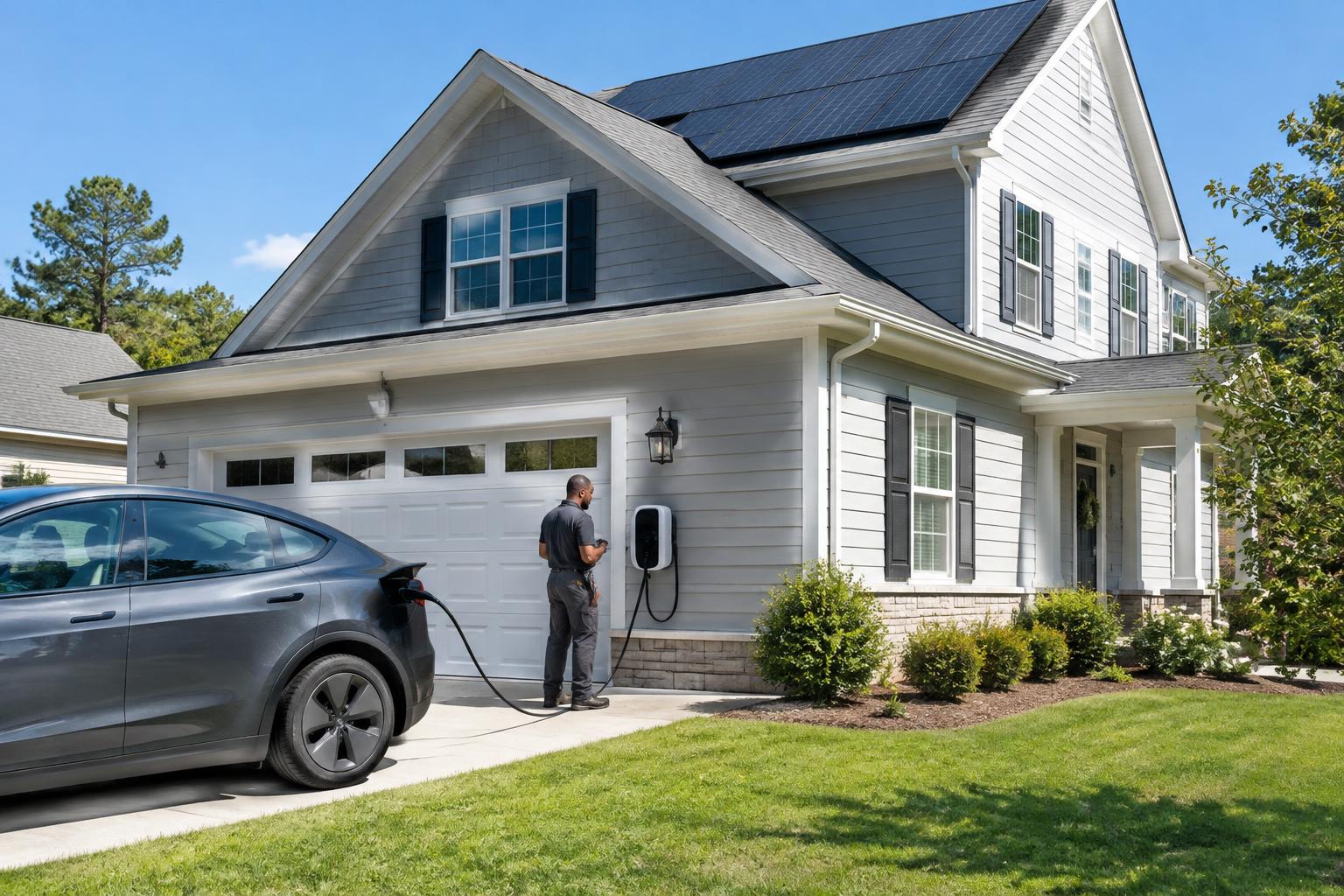
Can You Charge an EV With Solar Panels? A Homeowner's Guide
Table of Contents
- How Solar Electricity Reaches Your EV Battery
- How Many Solar Panels to Charge an Electric Car
- Setting Up a Solar Panel for EV Charging at Home
- Solar-Only Charging vs. Grid-Assisted Charging
- The Cost of Solar Panels to Charge Electric Cars
- Portable Solar Panels for EV Charging: What They Can and Can't Do
- Charging Speed, Sunlight, and Weather: What Affects Your Charge
- Planning Your Solar EV Charger Install in North Charleston
- Frequently Asked Questions
Reviewed: November 9, 2026. EmergenServe installs EV chargers and related electrical work; solar array design and utility interconnection are coordinated with your solar provider and utility. Incentive information is general, not tax advice.
Key takeaway: Yes, you can charge an EV with solar panels. Rooftop panels make DC power, an inverter converts it to AC for your home, and a Level 2 charger supplies the car, whose onboard charger converts it back to DC for the battery. Charging while the sun is up, or storing solar in a home battery, increases the share of solar miles.
How Solar Electricity Reaches Your EV Battery
Yes, you can charge an EV with solar panels, and the path from sunlight to battery is simpler than many homeowners expect. Solar panels make direct current (DC) electricity, as the DOE's solar photovoltaic basics explain. Your EV battery also stores DC power. In between, your home runs on alternating current (AC), so power changes form along the way.
Here is the typical chain for a home Level 2 setup:
- Photovoltaic modules on your roof absorb sunlight and produce DC electricity.
- An inverter converts that DC into AC power your home can use, as described in the DOE's inverter basics.
- Your Level 2 charging station supplies AC power to the car, and the vehicle's onboard charger converts it to DC for the EV battery.
- Surplus solar your home doesn't use may flow to the grid or a home battery, depending on the system and your utility arrangement.
Each conversion loses a small amount of energy, so solar-to-EV charging is never perfectly efficient.
How Many Solar Panels to Charge an Electric Car
The number of solar panels needed to charge an electric car depends on your daily mileage, your vehicle's efficiency in miles per kilowatt-hour, and how much usable sun your roof receives. Run the numbers rather than guessing.
A practical way to estimate how many solar panels to charge an electric car:
- Daily miles: Track a typical week of driving and average it.
- Vehicle efficiency: Check your car's miles-per-kWh figure; it varies by model, speed and season.
- Daily kWh needed: Divide daily miles by miles per kWh. For example, a 30-mile day at 3 miles per kWh needs about 10 kWh at the battery.
- Add charging losses: Charging loses some energy as heat, so plan for more solar production than the energy delivered to the battery.
- Panel count: Divide by your panel's expected daily output, which depends on its rating, orientation, shading and season.
Lowcountry sunlight helps, but cloud cover, summer heat (which slightly reduces panel output), roof orientation and shading all affect production. Your solar provider can model expected output for your roof.
Watch out: sizing an array for your EV and then charging only at night means the car is drawing grid power while the array exports during the day. If the goal is solar miles, schedule charging during daylight where your routine allows, or add a home battery.
Setting Up a Solar Panel for EV Charging at Home
A safe solar panel for EV charging at home setup follows a clear order. Skipping steps is how homeowners end up with overloaded equipment or failed inspections.
Timing: Varies by equipment, permits and utility review. Who does it: Licensed professionals for the electrical work and the solar system.
What you'll need:
- A solar array sized for your household and driving
- A Level 2 charging station
- Electrical capacity for the added load
- Required permits and utility interconnection approval
The sequence:
- Have the electrical system assessed for capacity, breaker space and planned additions.
- Size the solar array with your solar provider around your energy use.
- Install the Level 2 charger on a dedicated circuit.
- Coordinate interconnection with your utility through the solar provider.
- Complete required inspections before the systems are put into service.
Watch out: connecting a charger without confirming capacity can cause nuisance tripping or overheating. A panel's rating or age alone does not determine whether an upgrade is needed; where appropriate, an approved load-management system can allow EV charging without a service upgrade. For charger levels and installation expectations, download the printable EV Charger Installation Guide.
Solar-Only Charging vs. Grid-Assisted Charging
Solar-only charging means the car runs on sunshine and stored solar power. Grid-assisted charging blends solar with utility power so you can still charge on a cloudy day.
Here's the honest trade-off:
| Setup | Often Suits | Main Limitation |
|---|---|---|
| Solar-only | Light daily drivers who park at home in daylight | No direct solar charging after dark |
| Grid-assisted | Most households, longer commutes | Uses some utility power |
| Solar + battery | Evening charging from stored solar; some outage backup | Higher upfront cost |
Many households choose grid-assisted charging, which allows overnight charging when needed. A professional Level 2 install with any needed load management makes this straightforward, which is where EV charger installation in Charleston comes in.
The Cost of Solar Panels to Charge Electric Cars
The cost of solar panels to charge an electric car depends on array size, inverter type, battery storage, charger choice and whether electrical work is needed. There's no single number, so build your budget from itemized quotes.
What drives the total:
- System size and panel count. Pricing varies by market, equipment and system size.
- Inverter type. String inverters, microinverters and DC optimizers differ in cost, shade tolerance and monitoring.
- Battery storage, if added. Home batteries are a separate line item and often the largest add-on; they make evening solar charging and some outage backup possible.
- Level 2 charging hardware. Cost depends on amperage, cable length and smart features.
- Electrical work, if capacity is short. Panel work, a service upgrade or load management should be assessed before you buy hardware.
- Permits and interconnection. Requirements and fees vary by jurisdiction and utility; confirm them before installation.
Federal incentive date check: the IRS Residential Clean Energy Credit page states the credit is not available for property placed in service after December 31, 2025. Do not count it for a new 2026 solar or battery project; confirm any state or utility program, and consult a tax professional about past claims.
A realistic way to frame the decision is to compare the all-in cost of the solar-plus-charger package against what you would otherwise spend on fuel or grid electricity for the same miles. Payback varies by household and depends on energy prices, usage and your utility's rules for exported solar.
For the EV side, EmergenServe provides a free written project estimate with equipment and included work identified separately; send photos and project details for an estimate without a required onsite visit. If panel work turns out to be needed, our North Charleston panel upgrade page explains what is involved.
Portable Solar Panels for EV Charging: What They Can and Can't Do
Portable solar panels can add a little range in some situations, but they will not replace a home system.
What they can do:
- Add a small amount of charge to a parked car over many hours, with compatible equipment
- Power accessories on a camping trip
- Charge small devices through a portable power station
What they can't do:
- Deliver Level 2 charging speeds
- Fill a depleted EV battery quickly
- Match a rooftop solar array for daily driving
Think of portable panels as a top-off tool, not a fuel station. For daily charging, a grid-tied home solar system with a properly installed charging station is the practical path.
Charging Speed, Sunlight, and Weather: What Affects Your Charge
Charging speed and solar output both change with conditions.
Charging speed depends on your equipment and vehicle. Level 1 charging is slow, adding only a few miles of range per hour, according to the DOE's Alternative Fuels Data Center. Level 2 charging is the common home choice and can replenish typical daily driving overnight, though a full charge by morning depends on the vehicle, battery size and starting charge.
Solar generation depends on:
- Sunlight and daylight hours
- Weather conditions and cloud cover
- Roof orientation and shading
- System size and panel count
Because solar output rises and falls, most homes pair panels with the grid or a home battery. Whether a grid-tied system or battery provides power during grid outages depends on how it is designed; many grid-tied systems shut down during an outage unless they include backup equipment.
Planning Your Solar EV Charger Install in North Charleston
Local planning makes the difference between a smooth project and a frustrating one. Coastal humidity, summer storms and utility interconnection rules all reward getting the details right the first time.
A licensed electrician can help with the parts that often cause problems:
- Assessing electrical capacity and whether load management fits
- Locating and installing the charger's dedicated circuit
- Selecting outdoor-rated equipment where the charger is exposed
- Coordinating required permits and inspections for the charger work
When you're ready, EV charger installation in North Charleston covers the charger side of the project. EmergenServe is a family-owned, licensed electrical contractor based in North Charleston. Same-day or next-day appointments may be available; we confirm the next window for your location and project.
Frequently Asked Questions
Can you charge an EV directly from solar panels?
Usually not panel-to-car directly. Most home systems route solar DC power through an inverter to the home's AC wiring, then to a Level 2 charger or a home battery before reaching the EV. Direct DC charging from an array requires specialized equipment and is uncommon in homes. For most Lowcountry homeowners, the practical path is a grid-tied solar array paired with a Level 2 charger.
How many solar panels do you need to charge an electric car?
It depends on daily mileage, vehicle efficiency and panel output. A driver covering about 30 miles a day in a car that gets roughly 3 miles per kWh needs around 10 kWh at the battery, plus charging losses. Panel count then depends on panel rating, roof orientation, shading and season. Your solar provider can size the array against your actual usage.
Can portable solar panels charge an EV?
They can add a small amount of range with compatible equipment, but they are not a practical primary charger. Portable panels work best as a top-up at a campsite or remote site, not as a substitute for a home Level 2 charger.
Do I need a home battery to charge an EV with solar panels?
Not strictly, but it changes how much of your charging is solar. Without a battery on a grid-tied system, surplus solar typically flows to the utility and you draw grid power at night. A home battery lets you store daytime production for evening charging. Whether it pays off depends on your utility's rules for exported solar and how much you drive, so ask your solar provider to model both scenarios.
