
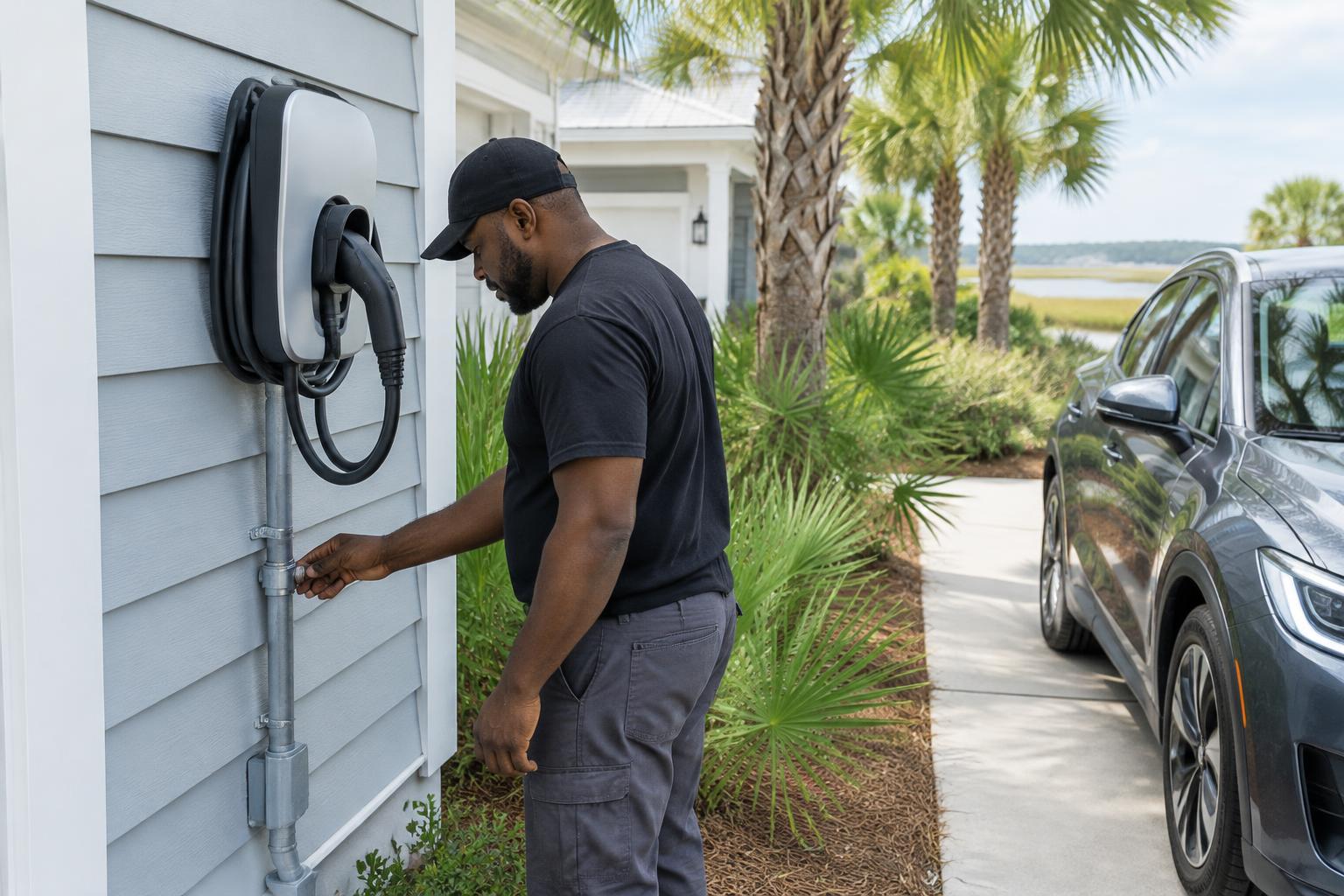
Can You Install an EV Charger Outside? What to Know
Table of Contents
- Can You Install an EV Charger Outside? The Short Answer
- Why Outdoor EV Charger Installation Works in the Lowcountry Climate
- Choosing a Weatherproof EV Charger for Outdoor Use
- EV Charger Installation Distance From Electrical Panel
- EV Charger Installation Permit North Charleston Requirements
- Level 2 EV Charger Installation Cost: What Drives the Price
- Common Mistakes to Avoid With an Outdoor EV Charger
- Schedule Your Outdoor EV Charger Installation
- Frequently Asked Questions
Reviewed: November 9, 2026. Equipment ratings, permits and prices depend on the selected charger, the address and the agreed scope.
Key takeaway: Yes, you can install an EV charger outside. Choose equipment listed and rated for outdoor use, follow the manufacturer's installation instructions, and have a licensed electrician install the circuit with any required permit and inspection.
Can You Install an EV Charger Outside? The Short Answer
Yes, you can install an EV charger outside. Outdoor EV charger installation is common when the unit is listed for outdoor use, mounted as the manufacturer specifies, and wired to the applicable code.
The key is choosing the right equipment and mounting it correctly. A weatherproof EV charger with a suitable enclosure rating is designed for rain and outdoor exposure, but no rating guarantees immunity from salt corrosion, flooding or storm damage. The wiring behind it matters just as much as the box on the wall.
The work needs a licensed electrician, any required permit and inspection, and an electrical system with capacity for the load. Skip any of those and the install can fail inspection or create a real hazard.
Below, we explain what outdoor installation involves, from NEMA ratings to panel distance to permits.
Why Outdoor EV Charger Installation Works in the Lowcountry Climate
The real challenge here is moisture, not cold. Coastal humidity and salt air are hard on low-quality hardware, and equipment that is not rated for outdoor exposure can corrode or fail early.
Three local factors shape every outdoor job:
- Salt air speeds corrosion on metal enclosures and exposed fasteners
- Heavy summer rain calls for equipment and fittings rated for wet locations
- Afternoon heat makes the manufacturer's operating-temperature range and any sun-exposure guidance worth checking
Mounting a charger under an eave or carport helps, but it does not replace an outdoor rating. The hardware itself has to be listed for the location.
Choosing a Weatherproof EV Charger for Outdoor Use
Pick a charger with an enclosure rating the manufacturer lists for outdoor installation; NEMA 3R is a common minimum. NEMA 4 adds protection against hose-directed water, and NEMA 4X adds corrosion resistance, which can be worth considering near the coast.
Many installers prefer a hardwired unit on an exterior wall because it removes an outdoor plug-and-receptacle connection. If you choose a plug-in charger, the receptacle, weather-resistant cover and circuit protection must suit an outdoor wet location and the charger's instructions.
Look for these features before you buy:
- An outdoor-rated enclosure suited to the exposure, such as NEMA 3R, 4 or 4X
- Hardwired or properly rated plug-in connection as the manufacturer allows
- Required ground-fault protection for the equipment and circuit
- A holster or cradle to keep the connector off the ground
- A safety listing from a nationally recognized testing laboratory, such as UL
What NEMA Rating Means for Rain and Humidity
A NEMA rating describes how an electrical enclosure is designed to resist environmental conditions such as rain, hose-directed water and corrosion. It describes specified protection, not a guarantee against salt damage, flooding or hurricanes.
Here is how the common ratings compare:
| NEMA Rating | Water Protection | Corrosion Resistance | Often Considered For |
|---|---|---|---|
| 3R | Rain, sleet, snow | Not specified beyond basic | Covered or sheltered outdoor walls |
| 4 | Rain plus hose-directed water | Not specified beyond basic | Exposed walls |
| 4X | Rain plus hose-directed water | Added corrosion resistance | Coastal exposure |
EV Charger Installation Distance From Electrical Panel
Shorter runs usually cost less. Keep the charger within a practical distance of the panel, and check the electrical system's available capacity first.
Voltage drop is the hidden cost of a long run. The farther the wire travels, the larger the conductors may need to be, which adds material and labor. Trenching or conduit across a property adds more.
Before mounting anything, confirm the electrical system can handle the added load. A panel rating or the age of a home alone does not determine whether an upgrade is needed; an electrician assesses equipment condition, breaker space, the calculated load and planned additions. Where appropriate, an approved load-management system can allow EV charging without a service upgrade. Our North Charleston panel upgrade page explains when panel work is the right answer.
Plan for these placement points:
- Mount the charger where the cable reaches the car's port without strain
- Follow the manufacturer's mounting height and code requirements, above grade and away from standing water
- Leave clearance for the connector holster and cord
- Avoid running cable where vehicles can strike it
EV Charger Installation Permit North Charleston Requirements
New EV charger circuits typically require an electrical permit and inspection. The permitting authority depends on the property's actual address: an address with a North Charleston mailing address may fall under the city or the county. For EV charger installation in North Charleston, we confirm the authority for your address and coordinate the required permits and inspections.
Skipping a required permit is a bad trade. Unpermitted work can complicate insurance claims and surface as a problem when you sell the home. Inspectors typically review the wiring, grounding, circuit protection and mounting.
The process usually follows these steps:
- The electrician obtains the permit from the authority for your address
- The crew installs the circuit and mounts the charger
- The inspector reviews the work as required
- Operation is tested and the job is closed out
Level 2 EV Charger Installation Cost: What Drives the Price
Level 2 EV charger installation cost depends on the charger, the run length, panel capacity, mounting location, and any trenching, load management, service upgrade, permit or inspection work. Pricing varies by job, so get a written estimate rather than guessing from a national average.
Four things move the number most:
- Distance from the panel (longer runs can need larger wire and more conduit)
- Panel or service work if available capacity is short
- Mounting type (wall vs. freestanding pedestal)
- Permit and inspection fees
A simple wall mount near a panel with available capacity typically costs less than a detached garage feed or a project that needs service work. EmergenServe provides a free written project estimate with equipment and included work identified separately, and you can send photos and project details for an estimate without a required onsite visit.
Common Mistakes to Avoid With an Outdoor EV Charger
The most avoidable outdoor mistake is using a charger that is not rated for outdoor installation. It can look fine at first, then corrode or fail. Buy for the outdoors from day one.
Other errors show up again and again:
- Mounting the charger lower than the manufacturer allows, where splashing water reaches it
- Omitting required ground-fault protection
- Running undersized wire for a long run
- Leaving the connector on the ground
- Ignoring electrical capacity before buying the unit
Watch out: an unpermitted install can fail a later inspection and complicate an insurance claim if a problem traces back to the circuit. Ask your electrician to confirm the permit.
Coastal and barrier-island properties need extra attention to equipment selection, fasteners and elevation. See how we plan EV charger installation in Isle of Palms for salt-air exposure.
Schedule Your Outdoor EV Charger Installation
Outdoor charging is a solvable job. The right outdoor-rated unit, a code-compliant circuit and any required permit turn a tricky install into a safe, lasting one.
EmergenServe is a family-owned, licensed electrical contractor serving the Charleston Lowcountry. Same-day or next-day appointments may be available, but we confirm the next available window for your location and project. Our residential workmanship warranty lasts for the lifetime of your home ownership for the original homeowner only and is not transferable; charger equipment follows the manufacturer's warranty terms.
Don't guess at panel capacity or weather ratings. Schedule your outdoor EV charger installation or download the printable EV Charger Installation Guide first.
Frequently Asked Questions
Can you install an EV charger outside?
Yes. Outdoor EV charger installation is common when the equipment is listed for outdoor use and installed correctly. Choose a unit with an outdoor enclosure rating such as NEMA 3R or higher, mount it under an eave or carport where practical, and have a licensed electrician install a dedicated circuit with the required protection. In the Lowcountry's heat and humidity, proper sealing and conduit routing matter as much as the charger itself.
Are outdoor EV chargers waterproof?
Most outdoor-rated chargers are designed to resist water rather than be fully waterproof. A NEMA 3R rating covers rain, sleet and snow, while NEMA 4 adds protection against hose-directed water. No charger should be submerged. Follow the manufacturer's mounting height, keep the connector holstered when not in use, and make sure any receptacle or hardwired connection is rated and sealed for the location.
Do I need a permit to install an EV charger in North Charleston, SC?
New EV charger circuits typically require an electrical permit and inspection. Which authority issues it depends on the property's actual address, not only its mailing city. Your electrician should confirm the authority, verify that your electrical system has capacity for the charger's dedicated circuit, and coordinate the inspection. Skipping a required permit can complicate insurance claims and create problems when you sell the property.
How much does it cost to install an outdoor Level 2 EV charger?
Level 2 EV charger installation cost depends on the charger, distance from your panel, whether panel or service work is needed, conduit or trenching, load management and permit fees. A straightforward install close to a panel with available capacity typically costs less than a long run to a detached garage or driveway. EmergenServe provides a free written estimate from photos and project details, without a required onsite visit.
